The first conspicuous opportunity for us to learn starts at birth. Never again does learning happen at such an accelerated pace than in the first few months when a newborn begins to uncover the world through the perceptive stimuli of his or her environment. While developing the senses of sight, taste, smell, hearing and touch, the newborn begins to learn how to consciously interact with this environment beyond the subconscious brilliance inherited through the parental genetic fingerprint.
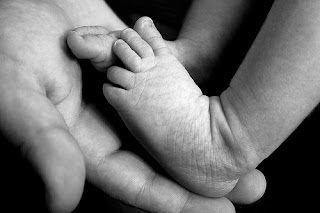
Baby in Hand by Aldo Risolvo
According to Dr. Robert Titzer, a California-based infant researcher "[t]he natural window of opportunity to learn opens at birth and begins to close at the age of four." In an article written by Matthew Coutts, Dr. Titzer recommends to parents that they should be reading to their babies by the time they are 3 months old (article).
Unfortunately, the National Post article overshoots the purpose of the early-reading recommendation. It's not meant to mold the baby into a child prodigy; it's to give the child a good start to life the same way that a parent focuses on good post-natal nutrition. A newborn is a sponge for the knowledge that their surroundings offer and they will learn considerably more from a used children's book than they will from a Baby Einstein DVD. Unlike the DVD, the book allows the child to interact directly with the learning tool at his or her own pace. Furthermore, the action of reading helps strengthen the communication bond between parent and child in a way that the unilateral television-based visual tool will not do. An increasing number of studies directly link television to decreased learning ability in addition to attention deficit hyperactivity disorder (ADHD) and other learning disabilities. The challenge for most parents is finding the time to read because television is a very effective distractor for babies thus freeing up time in a busy parent's life. This also implies that the parent needs to significantly reduce and ideally eliminate the hours he or she spends watching television, which is by no means an easy lifestyle change to make. There are some who believe that television is exploited by the elite and wealthy as a means to keep people from moving up into higher socioeconomic classes in a globalized world where the opportunity to learn and gain knowledge is so widely accessible. Proponents of this theory note that many highly educated parents do not let their children watch any television at all. Literacy rate is a strong indicator of economic wealth and while even the poorest neighbourhoods in the United States now have television, they also have alarmingly low functional literacy rates. This digression to the connection between television, literacy and socioeconomic wealth is another topic in itself.
Taking a step back to when a newborn first opens his or her eyes, this moment is the only time in a person's life when intellectual capacity exists in a way that is effectively unaltered by the external environment. Psychologist Cyril Burt termed this intellectual capacity 'innate general cognitive ability'. It is essentially the genetically inherited capacity to gain intelligence. Unfortunately, we have no way to measure this quantity and thus there is no way to determine how smart one can realistically become. What really matters though, is that babies are nurtured to make optimum use of the available learning channels.
Coming up in my next post, I will define the 'smart' adjective in 'You're Smarter Than You Think.'


.jpg)