 There have been many predictions about what the price of crude oil will do as a result of Hurricane Gustav, which is expected to make landfall very close to where hurricane Katrina did. Gustav is also expected to make landfall as a category 3 storm (Katrina had been a category 5 but weakened to Category 3 before making landfall).
Idle Production
Currently, nearly all oil production in the area is shut in, with all personnel evacuated. According to Bloomberg, "96 percent of offshore oil output and 82 percent of gas production" is currently idle. The Gulf region produces a quarter of U.S. domestic oil production and 14 percent of natural gas production. Nearly all operations personnel have been evauated while many refineries and piplines in the area have also been closed.

A couple of days of reduced supply isn't enough to raise prices significantly. The large price spikes in 2005 were due to the damage in the aftermath of Hurricane Katrina that took months to fix, rather than these temporary shut-ins. It's also quite likely that this increased idling simply means oil producers are better prepared and less damage will ensue from the hurricane season this time around. Any production lost due to downtime and minor damages can easily be replaced with oil from the strategic petroleum reserve, which was intended for--and only capable of--replacing temporary and unforeseeable supply disruptions like Hurricanes (rather than to stabilize normal market price volatility, a purpose some people thought of it earlier this year).
Up Or Down?
Sixteen economists polled last week were split almost evenly three ways (I don't recall which poll). About one third said prices would simply fall after the hurricane passes. Another group said prices would remain about the same. The last third of these economic experts said prices could rise significantly. Prevalent Canadian economist Jeff Rubin of CIBC's World Markets thinks gas prices could hit $1.75-a-litre if this year sees "[a]ny replays of the 2005 hurricane season". Ultimately though, what happens will depend on Mother Nature (or global warming for those who speculate that this is the case). Many others think this scenario is unlikely.
Inflation Outlook
If the most active part of the hurricane season does create major disruptions to energy supply in the Gulf, the resulting increase in energy prices could kill the plans of the U.S. Federal Reserve Bank to hold rates steady this year. Ben Bernanke expects to see inflation moderate from an annual pace of 5.6% in July if oil prices remain relatively low compared to their all-time highs of $147-a-barrel. The Fed does not want to raise interest rates until some parts of the "financial storm" passes, which include the housing crisis and credit crunch, high commodity prices and a low greenback.
My Prediction
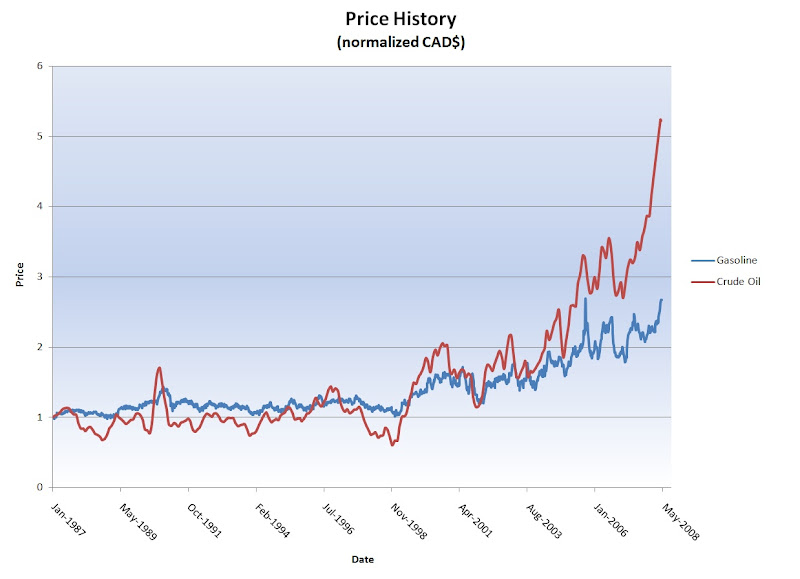
I'd say there are several indicators that show the markets are comfortable with a crude oil price in the $110-$120-a-barrel range for the next couple months, with some spikes possible. Even with a spike, a repeat of Katrina is unlikely and therefore the odds are that the price won't stray too far outside this range, up or down. It also seems like a stable and sustainable range as an OPEC official has said his organization will cut production if oil falls below $85-a-barrel (Iran has less clout but their oil minister wants OPEC to set this floor at $100); on the high end, airlines and car manufacturers start failing if oil goes above $150-a-barrel (Zoom airlines failed last week with oil below $120). My prediction also translates into gas prices in the range of $1.15 to $1.35 for the fall, depending on what the loonie does relative to the greenback.
Meteorologists are about as good as predicting the weather tomorrow as energy analysts are at predicting crude oil prices next week, even without a hurricane. It seems we'll just have to wait and see how these factors come together. At least the one certainty is that the loss of human life this time around won't be anywhere near as bad, assuming that lessons were learned from Hurricane Katrina.



.jpg)
